As a result of a long-standing relationship with one of the UK’s leading suppliers of rescue submersibles, FCL have developed significant experience in the mechanical design of such vehicles.
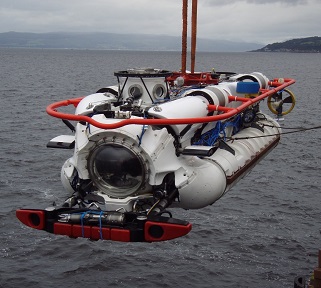
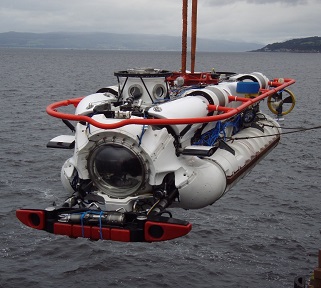
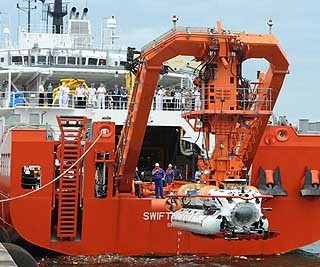
The most significant single project carried out involved the parallel development of two similar rescue submersibles for the Republic of Korea Navy and the Republic of Singapore Navy.
These vehicles each featured a two compartment hull, separated by a full depth rated bulkhead, and comprised a command module to accommodate the pilot and co-pilot, and a rescue chamber which could accommodate up to sixteen evacuees and the rescue chamber operator.
The rescue chamber incorporated an integral dry mating skirt to enable the transfer of submariners and rescues from distressed submarines.
Although the two vessels shared many common features, different operational requirements dictated the provision of an additional rear hatch in the second vessel, necessitating the production of two complete sets of design documentation.
A further challenge presented by the work was the aggressive project schedule agreed with the two customers, which dictated that a ‘concurrent engineering’ approach be adopted, in which fabrication took place in parallel with the design process.
With this in mind, FCL undertook the design work in three distinct phases:
The number of distinct components making up the complete submersible (command module, dry mating skirt, rescue chamber, conning tower, battery pods, hatches, viewports and other penetrations) combined with the large number of potential load cases (including several loading scenarios incorporating combinations of internal and external pressure, launch and recovery loading, towing loading and various potential collision scenarios) made it impractical to consider all loading conditions during the initial phases of the work, and FCL therefore needed to rapidly identify the most significant scenarios for each area of the design to ensure that the required level of confidence could be provided in a timely fashion.
Evidence of our success in this exercise was provided by the fact that no significant shortcomings were subsequently identified during the final detailed assessment of the design.
FCL’s formal design substantiation reports were prepared in accordance with PD5500 and Lloyd’s Register Rules and Regulations for the Construction and Classification of Submersibles and Underwater Systems, and were subsequently approved by Lloyd’s Register with minimal comments.
FAQs
Added January 2026.
The biggest challenge was the production of two completely separate sets of design documentation accounting for the significant differences between the two vehicles (an extra hatch on one vehicle, different lifting arrangements and significant variations in loading requirements) while also maintaining as much commonality between the designs as possible.These requirements were further complicated by the aggressive project schedule.
Principal dimensions and scantlings were set during an initial phase of work, which included the preparation of scoping calculations for those loading conditions identified as likely to limit based on previous experience. This approach permitted material ordering and the commencement of fabrication activities in parallel with ongoing detail design work.
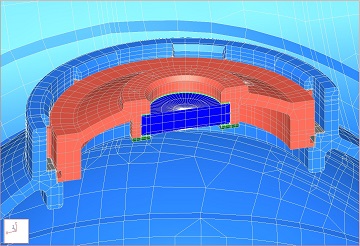
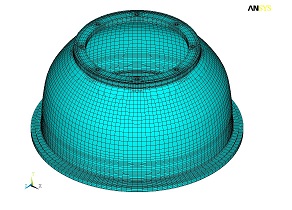
A dry mating skirt (DMS) is a hemispherical component attached to a rescue submersible, which forms the connection to a distressed submarine when rescue is required.
In broad terms, the dry mating skirt (DMS) is a hemisphere with a hatch into the rescue submersible at the top and a large flange at the open end, fitted with a thick rubber seal (imagine a very large sink plunger!). The rescue submersible is manouevered so that the DMS encloses the escape hatch on the distressed submarine, with the flange resting on the flat mating surface provided around the hatch by the submarine rescue seat. The pressure inside the DMS is reduced to pull a firm seal and the water inside the DMS is then pumped out. After careful equalisation of pressures, the hatches on the submarine and submersible may then be opened and submariners transferred into the rescue submersible. After completion of this transfer, the steps are reversed to enable the rescue submersible to disconnect and return to the surface.
Design and assessment of the dry mating skirt was carried out in accordance with PD 5500 and Lloyds Register Rules.
Concurrent engineering involves carrying out fabrication in parallel with the design process. Concurrent engineering was required on this project to meet the aggressive project schedule, which was insufficient to permit all aspects of the design to be finalised before commencing fabrication.
Although a potentially high-risk approach, FCL's experience and ability to rapidly identify the most significant loading scenarios for each area of the design enabled the selection of component thicknesses and key scantling dimensions, with a high level of confidence, at an early stage of the design process. This enabled rapid material ordering and an early start to fabrication, significantly reducing the overall project schedule.
The approach proved highly successful, with no significant shortcomings in the selected scantling dimensions identified by the subsequent detailed assessment of the design.

Please use this form if you have any questions about our capabilities or would like to obtain a quotation.
Alternatively, you are welcome to call or contact us by e-mail.
+44 (0)1992 585450 enquiries@finglowconsultants.co.ukYour enquiry has been safely and securely received. Our office is open weekdays from 9am to 5pm - you can expect a response during the next 2-3 working hours.